A case study on designing a coordination platform for Quebec educators, shifting from fragmented communication to shared network infrastructure.
The Initial Ask
FQDE is an umbrella federation connecting educators, school directors, and regional associations across Quebec. Its mission isn’t just representational—it’s connective. It exists to foster collaboration across groups that otherwise operate in distinct regional silos.
When I joined as a UX consultant alongside an external development team, the original brief was framed around everyday communication needs:
Announce federation decisions and initiatives.
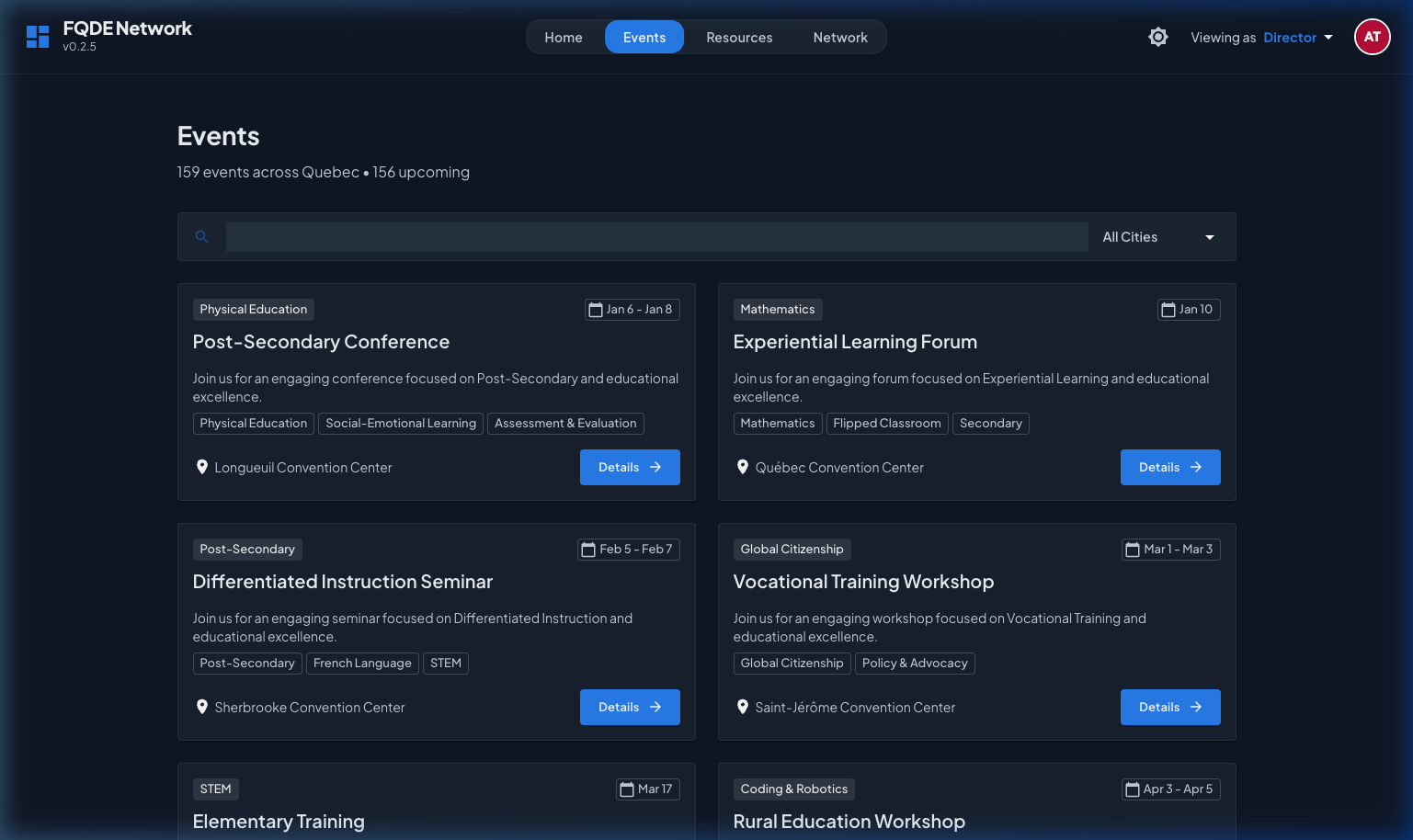
Promote conferences, sell tickets, and manage attendance.
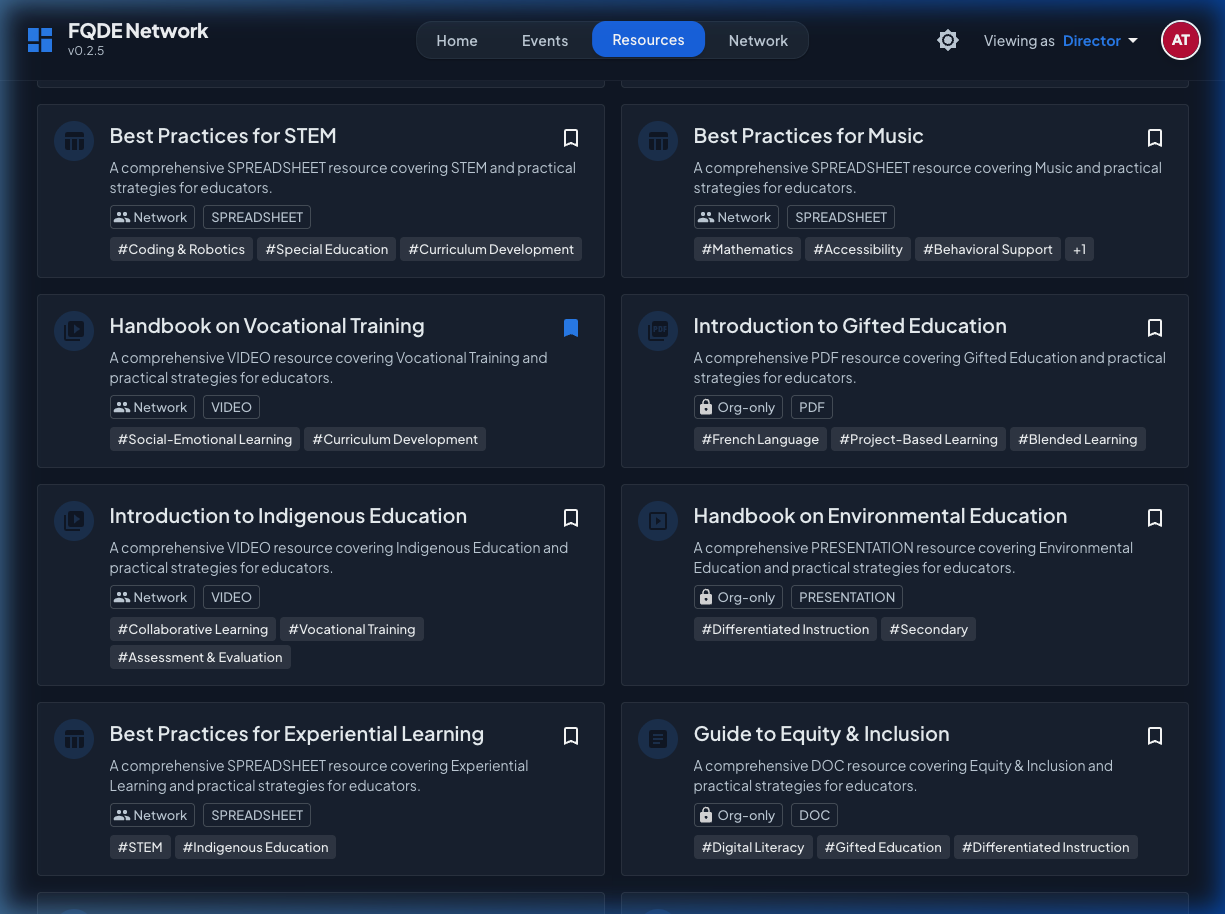
Share resources and legal/pedagogical documents.
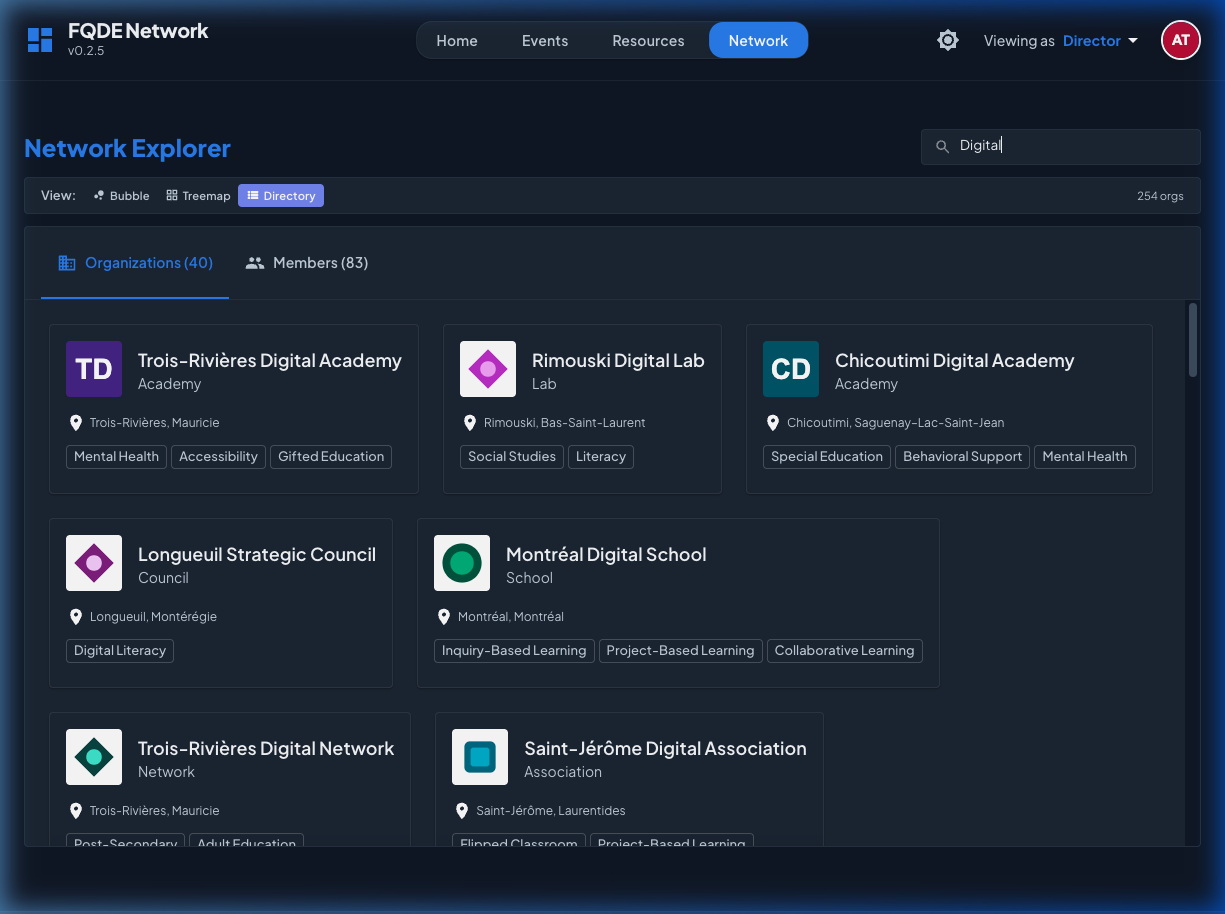
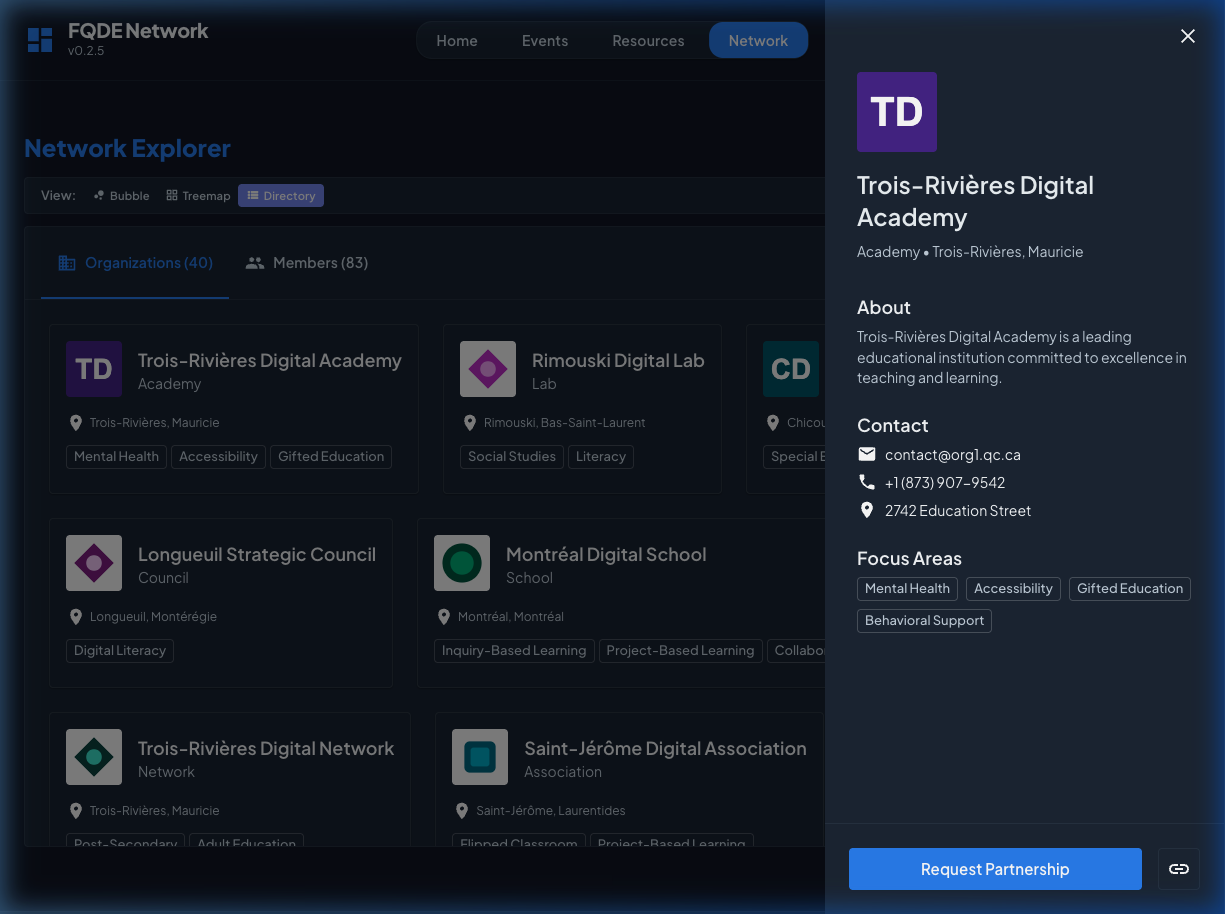
Make regional associations and their members visible to one another.
These were valid, pressing requests. But they assumed something that didn't exist yet: a shared system capable of handling coordination at scale.
A Fragmented Reality
Very early on, it was clear that the ecosystem lacked a single source of truth.
Coordination lived across private inboxes, informal phone calls, and disconnected spreadsheets. Nobody had a clear, reliable view of who was involved, which associations were active outside their own circle, or how information flowed.
Multi-day events clashed. Important initiatives got buried. Documents were duplicated privately or shared inconsistently.
None of this was a failure of effort or good intentions. It was a structural failure. When systems don't provide visibility, people don't stop communicating—they just spend an exhausting amount of time managing around the missing structure.
Discovery Through Real Conversations
To get past assumptions, I sat down with institutional directors, regional administrators, and school coordinators for semi-structured conversations.
The aim wasn’t to collect a feature wishlist. I wanted to understand where information broke down, how people actually discovered workshops and conferences, how scheduling conflicts were handled, and what informal workarounds had quietly become routine.
A distinct pattern emerged: complexity wasn't being navigated; it was being avoided. People defaulted to their immediate networks simply because looking beyond them was too noisy or confusing.
Two realizations reshaped the direction:
Visibility isn’t just broadcasting announcements—it’s about discovery. Educators genuinely wanted to discover peers, initiatives, and specialized associations beyond their immediate circle, but without losing sight of what mattered directly to their day-to-day work.
A single feed forces an impossible compromise. If you build one centralized activity stream, it either becomes too curated (and the broader ecosystem disappears) or too broad (and the signal gets drowned in noise). This tension was structural, so the interface needed to solve it structurally.
Designing with Time as a Coordination Tool
Rather than flattening everything into a conventional social feed or static directory, the architecture centered around time and reach.
Dual Timelines for Network Visibility
Instead of forcing an algorithmic compromise, we separated network attention into two parallel streams:
The Curated Pulse: A direct timeline reflecting updates, discussions, and initiatives from an educator's immediate circle, local district, and followed associations.
The Global Horizon: A high-level overview of everything happening across the province. It allows educators to look up from their day-to-day and see the wider ecosystem, without letting that broad activity overwhelm their daily focus.
Events as Navigable Temporal Systems
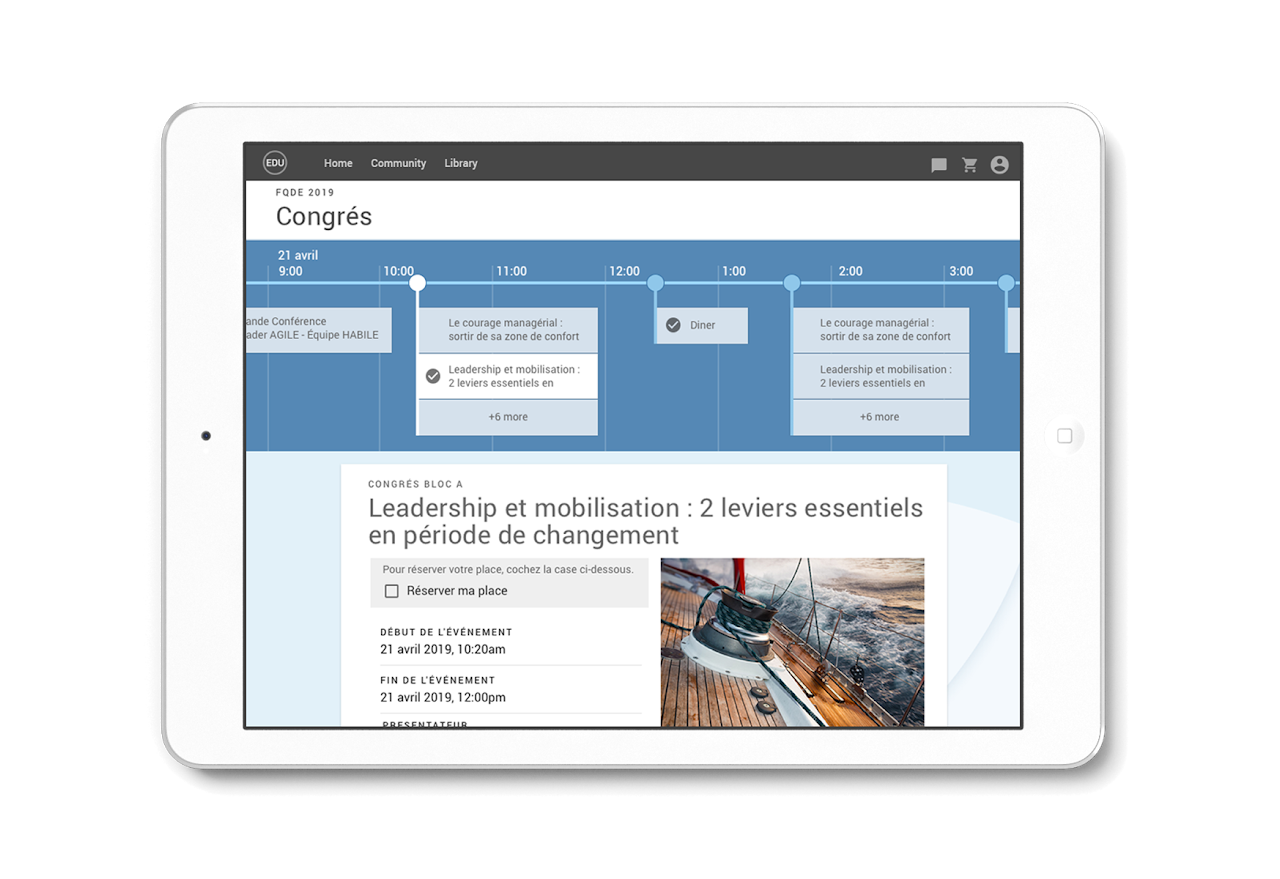
Interviews uncovered deep frustration around large, multi-day conferences. When an event runs across several days with parallel tracks, linear schedules break down. Attendees miss crucial sessions simply because they can’t visualize the program.
We treated events not as static landing pages, but as interactive, navigable systems:
Attendees can scan multiple tracks side-by-side across several days.
Overlapping time slots are immediately obvious rather than buried in tabs.
Users can browse the broader program, pick what matters, and build their own coherent personal agenda.
Browse, pick, and let that become your schedule. It’s an intuitive mental model, but making it effortless required careful interaction design.
Prototyping to Build Consensus
Because this project lived in an institutional environment with multiple stakeholders and an external engineering team, static wireframes and slide decks were never going to be enough. Abstract ideas about "dual timelines" or "interactive event matrices" needed to be experienced directly.

I built a fully functional front-end prototype using React, Vite, and D3.js, populated with a realistic synthetic dataset representing over 1,200 educators and 250 organizations.
The working prototype included:
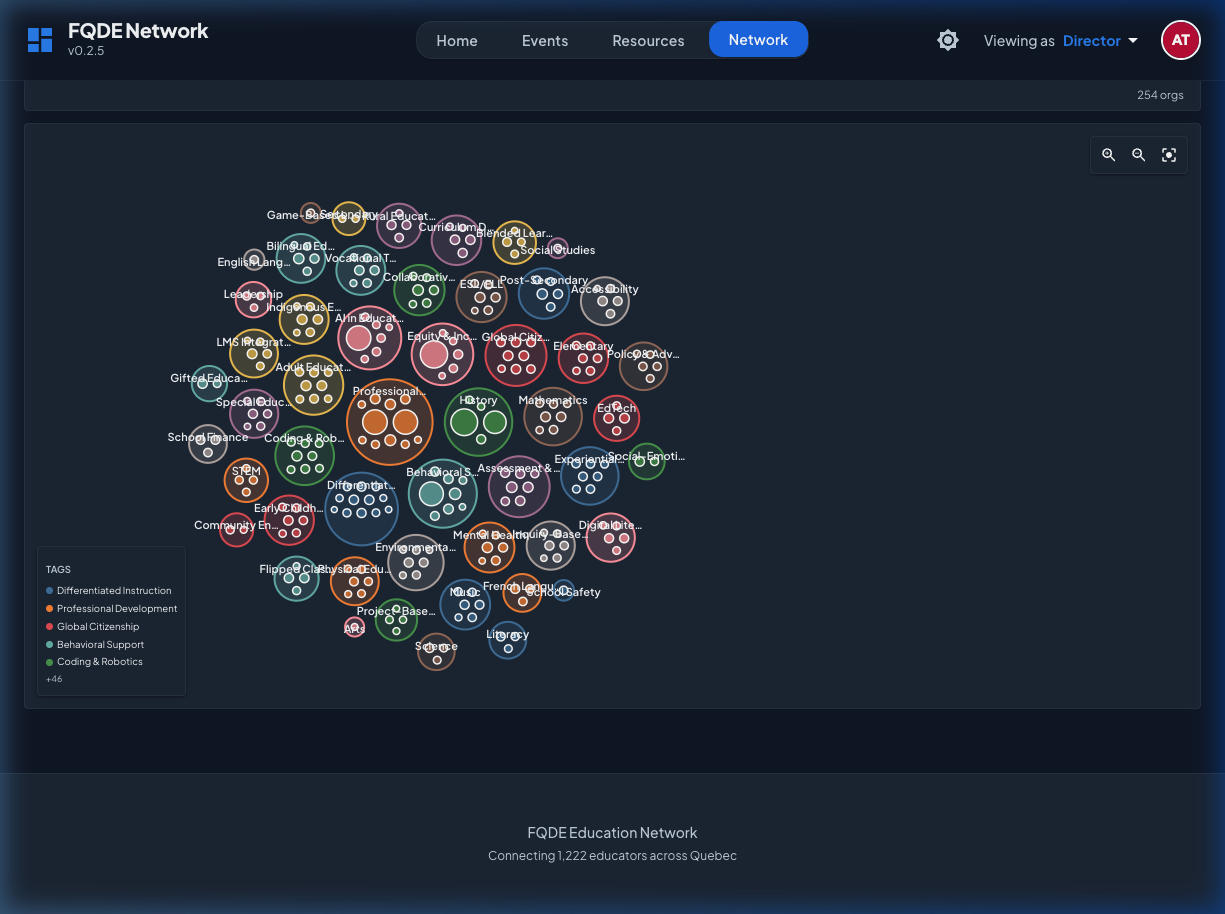
Interactive Network Visualization (D3.js): Translating abstract membership numbers into a living graph of associations, clusters, and collaborative links.
Faceted Directory Search: Responsive filtering across people, roles, regions, and institutions.
Dynamic Event Scheduler: A hands-on implementation of the multi-track timeline and personal agenda builder.
Resource Repository: Clear, structured access to shared documentation and pedagogical toolkits.
Building a functional prototype changed the room. It gave directors and developers a tangible artifact to evaluate, turning speculative committee debates into concrete decisions about workflows and implementation.
Outcome and Reflection
The prototype shifted FQDE’s perspective from building another static portal to investing in durable network infrastructure.
It gave educators agency over their own discovery and schedule, gave administrators a way to share complex programs without overwhelming people, and gave the development team an unambiguous behavioral blueprint.
This project reinforced a design truth I return to often: in complex human organizations, clarity doesn't come from pretending complexity doesn't exist. It comes from giving people clear, structured mental models so they can reason about it and make good choices.
Explore the Prototype
Open the interactive prototype · View the source on GitHub